Let us help you grow the business you love.
Your world is about to get a whole lot simpler.

Maintenance is never static. Pressures change, expectations rise, and teams are constantly asked to do more, faster, with greater visibility and control.
That’s why RedRabbit keeps moving forward. Not by reinventing what already works, but by continuously building on it – responding to real-world feedback and removing friction wherever it appears.
Our 2025 release of RedRabbit’s Ticketing-on-the-Go is a great example of this problem-solving approach to product development.
It was built to address a major operational challenge: maintenance issues were being identified, but they weren’t moving quickly or consistently into action.
Ticketing-on-the-go changed that, delivering three immediate, practical outcomes:
It worked exactly as intended – getting maintenance issues off the starting block faster than ever – and the response from users was overwhelmingly positive.
But with the challenge of ticket creation solved, it quickly became clear that the maintenance workflow still faced another significant roadblock.
Today, the biggest constraint in maintenance isn’t identifying issues or raising tickets. Those problems have largely been addressed.
The current challenge sits further along the workflow – in how maintenance is communicated, coordinated, and progressed once work leaves the office and enters the field.
This has become the most common point where momentum is lost. Not because people aren’t doing their jobs, but because once tickets are created, communication fragments – spreading across WhatsApp messages on personal devices, long email chains, and late or missing updates, with no clear audit trail or ownership of next steps.
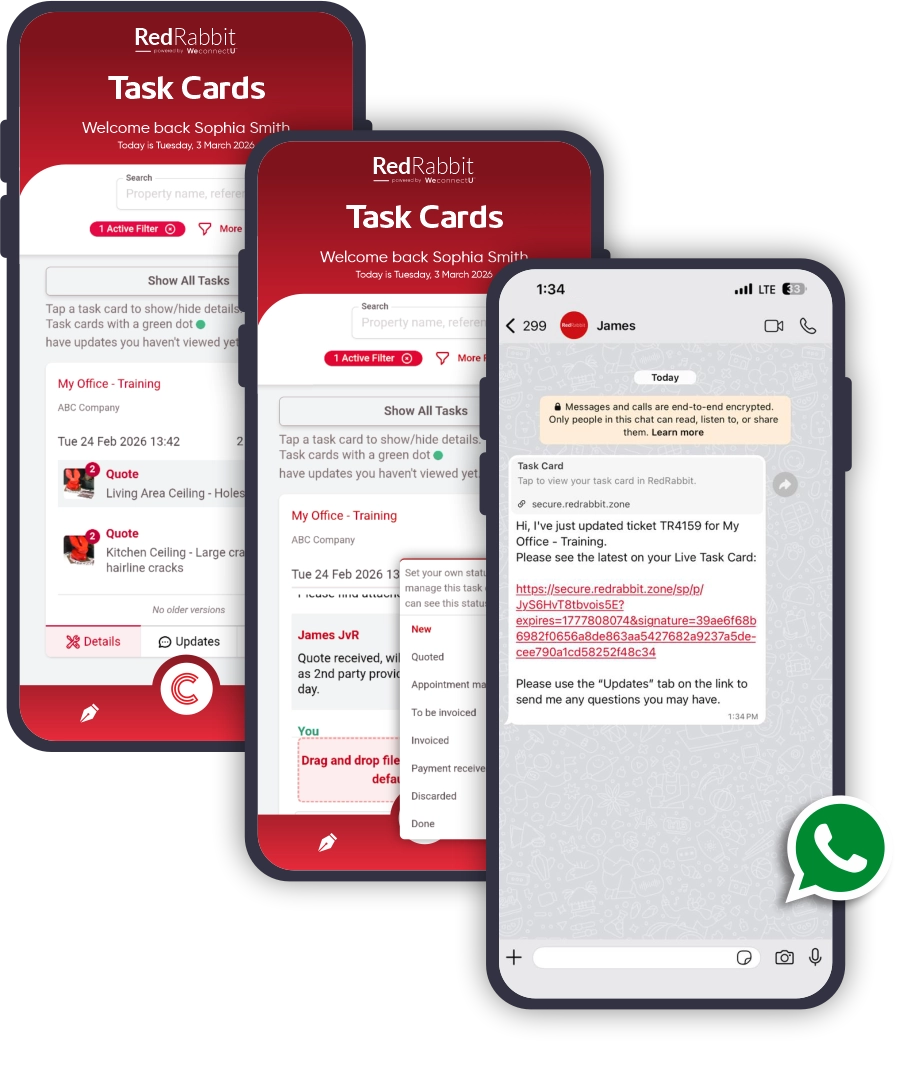
To keep maintenance moving, RedRabbit needed to go beyond ticket creation and address the communication layer itself. Not by adding another messaging tool, but by replacing unstructured conversations with a purpose-built, operational way of working.
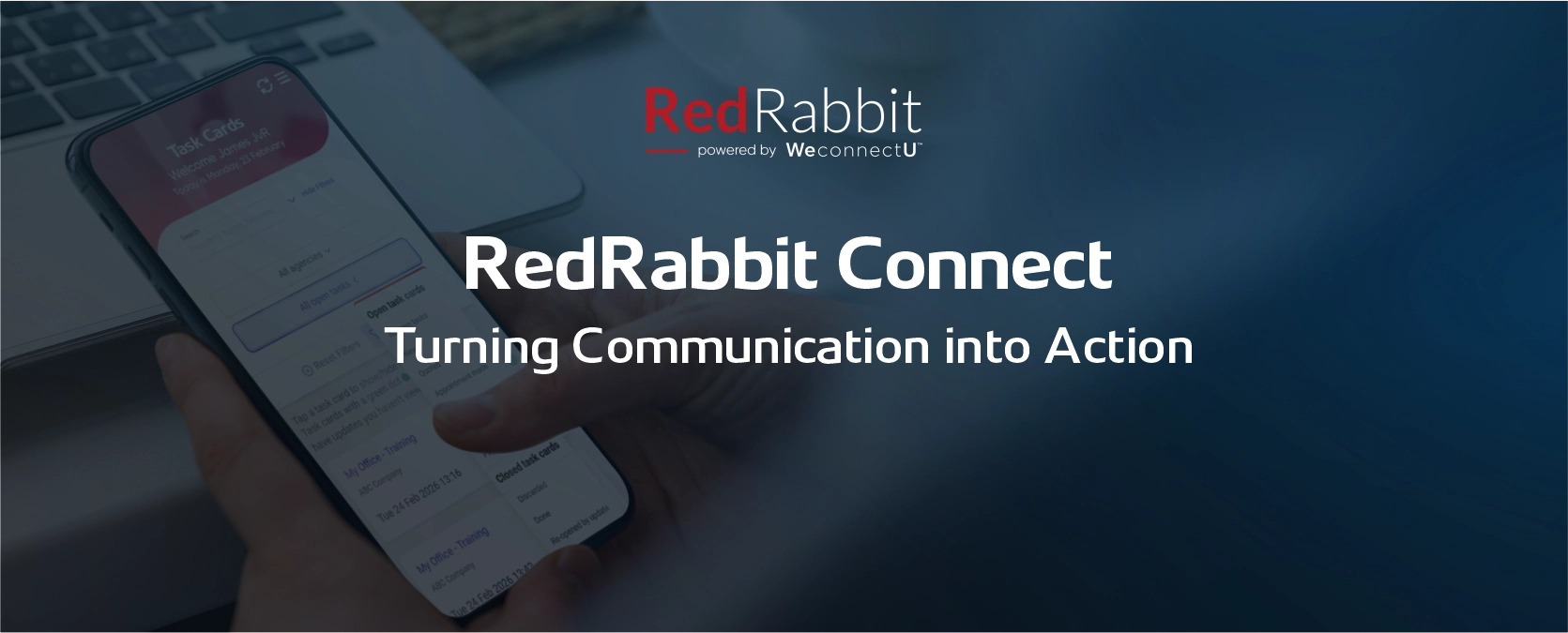
This is where RedRabbit Connect comes in – our latest, in-development capability, set to be unveiled at ENGAGE ’26.
Built as an integrated part of the RedRabbit platform within the WeconnectU ecosystem, RedRabbit Connect will complete the maintenance journey by transforming tickets into live, connected execution between teams and service providers. It replaces fragmented conversations with structured, visible progress – all anchored inside RedRabbit.
Because if communication is what keeps maintenance moving, then it needs to live in the same place as the work itself.
RedRabbit Connect brings this principle to life through LIVE Task Cards.
Instead of pushing maintenance conversations into disconnected tools, LIVE Task Cards keep communication anchored to the ticket itself – creating a single, shared space around each job.
Task Cards are shared instantly with service providers and accessed securely via OTP links delivered through familiar channels like WhatsApp or email. No apps, no logins, no paperwork.
As work progresses, updates are captured in real time and remain visible to everyone involved. Progress, decisions, and accountability stay connected to the work – not scattered across inboxes or chat threads.
The result is live execution with shared visibility, without changing how people work in the field.
With RedRabbit Connect in place, maintenance no longer operates in disconnected stages. What were once handovers are now a single, continuous flow, from the moment an issue is identified to the moment it’s resolved.
Inspection findings move seamlessly into tickets. Tickets flow into LIVE Task Cards. Updates, quotes, work, and invoices stay connected throughout.

There’s no loss of visibility halfway through the process, and no need to reconstruct what happened after the fact. Every step builds on the last, all within the RedRabbit platform and the wider WeconnectU ecosystem.
This is what turns maintenance from a series of touchpoints into a true end-to-end workflow.
Connecting the workflow doesn’t just improve execution – it transforms how maintenance is managed.
Because progress, updates, and outcomes are captured as work happens, RedRabbit’s insights and reporting move beyond static snapshots. Teams gain a clear view of how maintenance is actually flowing, where pressure points emerge, and what needs attention.
This builds on feedback RedRabbit already hears consistently today: not that there’s more information, but that maintenance finally feels manageable.
By extending that same visibility and structure through execution, RedRabbit Connect takes this a step further, ensuring insight isn’t just retrospective, but shaped by what’s happening in real time.
RedRabbit Connect isn’t a departure from what RedRabbit already does well. It’s the next step in a deliberate, problem-led approach to product development – never stopping at the first win.
Ticketing-on-the-Go removed friction at the start of the journey. Strong insights and reporting made maintenance more manageable. RedRabbit Connect extends that same thinking into execution, addressing the communication roadblock that still slows maintenance down today.
The outcome is simple but powerful: fewer handovers, less chasing, and clearer visibility from start to finish.
And that matters because maintenance teams were never meant to spend their time coordinating conversations and tracking updates. Their real value lies in managing relationships, making informed decisions, and shaping strategy – the work that actually moves portfolios forward.
RedRabbit Connect is set to redefine how maintenance is managed.
Join the official launch to see how you can eliminate communication gaps and keep maintenance moving.